


- Plays this season
- Premiere Year 2025
For seven hundred years, the south of Spain was part of a prosperous Moorish kingdom, in which Muslims, Jews and Christians lived together. The arts flourished, science flourished. In 1492, this came to an end, when Catholic Spain conquered the last Moorish city: Granada. What followed was a long process of persecution and expulsion of Muslims and Jews by the Spanish Inquisition.
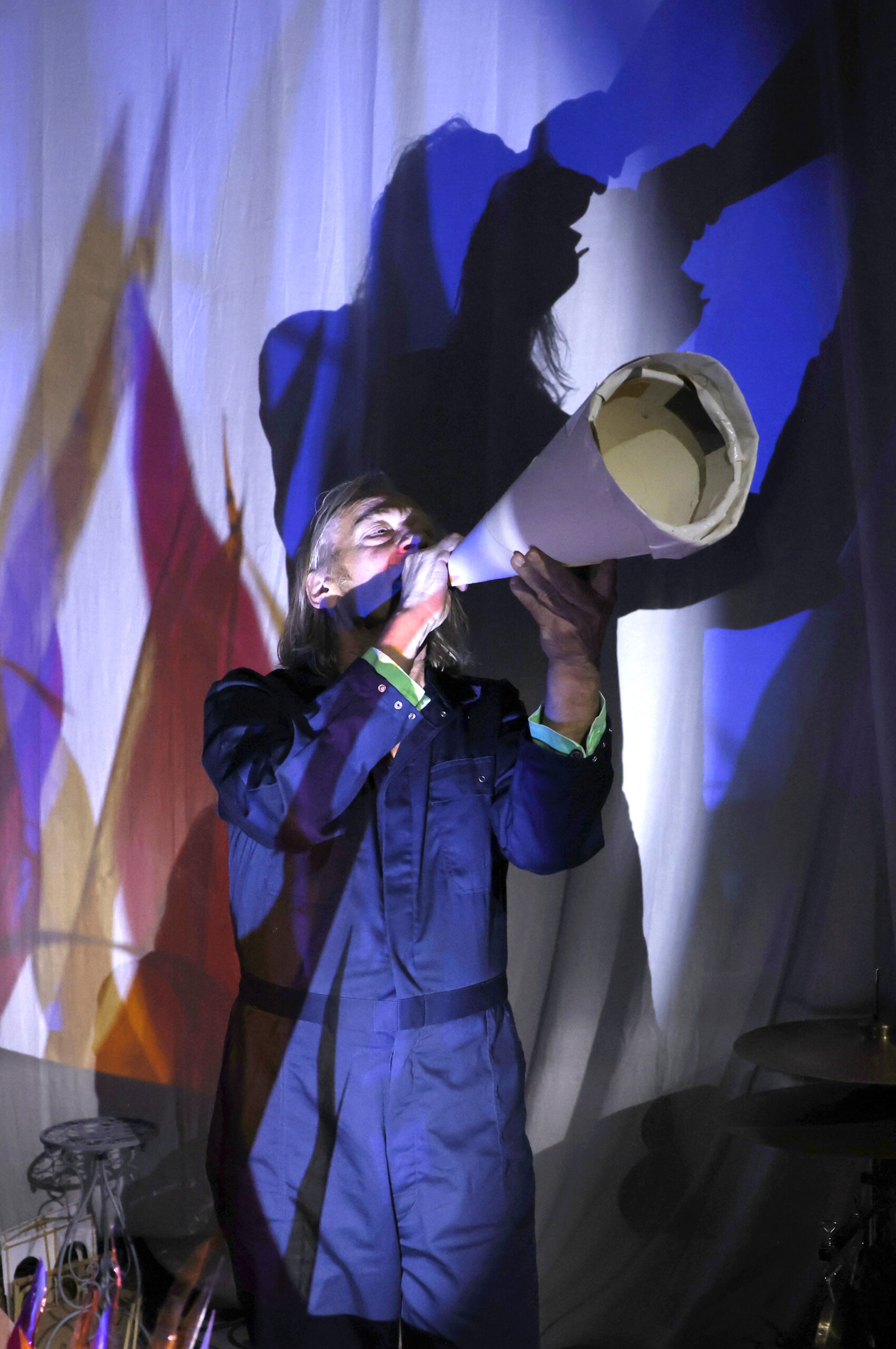
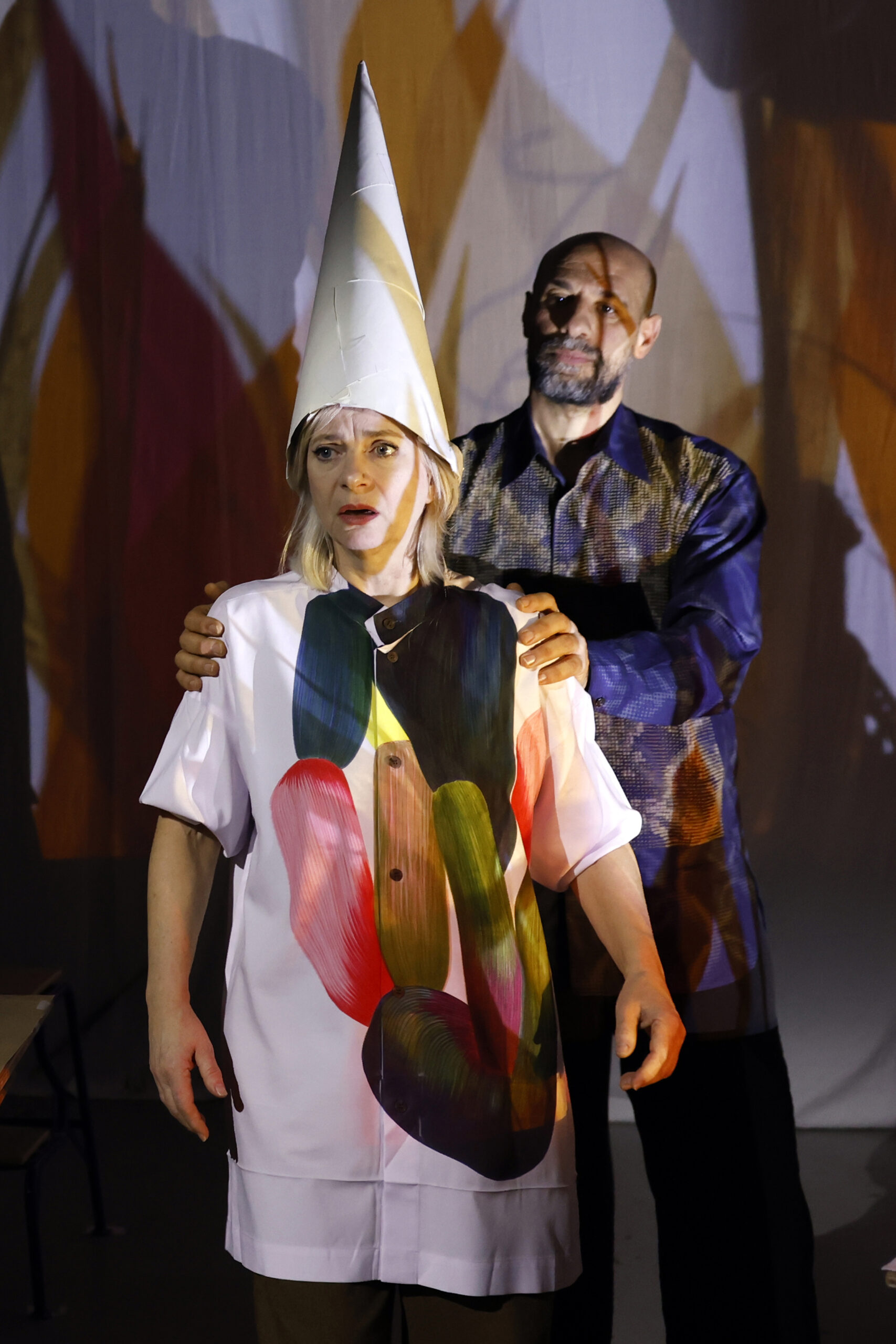
With spectacular shadow play and compelling storytelling, Hotel Modern and Abdelkader Benali bring the world of Granada to life: the moving stories, the dances, the painful loss and the unimaginable climax of the Fall.
In 2023, Hotel Modern met Abdelkader Benali while working for the NTR television series Jan Janszoon, Piraat van de wereld. Benali was the narrator in the series, we made animations. This series – broadcast in February 2024 – tells the story of the 17th-century Haarlem native Jan Janszoon who migrates to Morocco, makes a splash as a pirate and converts to Islam. Through conversations with Benali, Hotel Modern became interested in the rich cultural and religious exchange between North Africa and Europe and the idea arose to make The Fall of Granada together.
Abdelkader Benali (Ighazzazen, Morocco, 1975) is a writer and programme maker, and is known for his work in which he explores the themes of identity, multiculturalism and migration. He writes novels, essays, columns and plays. Hotel Modern and Abdelkader Benali are making De Val van Granada together.
-
Reviews & articles
-
A unique artistic alliance: Abdelkader Benali and Hotel Modern
A unique artistic alliance: Abdelkader Benali and Hotel Modern In the advertising world, there’s a well-chosen term for two distinct identities joining forces to create a new product: co-branding. A good example is the Senseo coffee machine made by Philips and Douwe Egberts. You find this form of collaboration in the arts, too, especially on […]
by Wiggele Wouda, Friesch Dagblad Read More
A unique artistic alliance: Abdelkader Benali and Hotel Modern In the advertising world, there’s a well-chosen term for two distinct identities joining forces to create a new product: co-branding. A good example is the Senseo coffee machine made by Philips and Douwe Egberts. You find this form of collaboration in the arts, too, especially on the stage, with partnerships between the likes of Freek de Jonge, Het Nationale Theater and The Nits.
At first, the idea of writer Abdelkader Benali joining forces with Rotterdam’s Hotel Modern to create ‘something’ may not seem obvious. But a closer look reveals that both bring their distinctive, expressive voices to conjure a visual reality that is moving, inventive, and confrontational.
Their partnership grew out of a joint historical television project, during which they discovered how limited their knowledge was of Spain – particularly of Moorish Islamic Spain and its reconquest (Reconquista) by Christian forces in the late Middle Ages. This shared gap in knowledge became their artistic driving force. Islamic rule in Spain ended with the completion of the Reconquista, the Catholic conquest of Granada in 1492. With this, the Iberian Peninsula (Spain and Portugal) entered a new era – one in which the traces of Arab civilisation, art, culture and science continued to endure and remain visible.
The Arab world
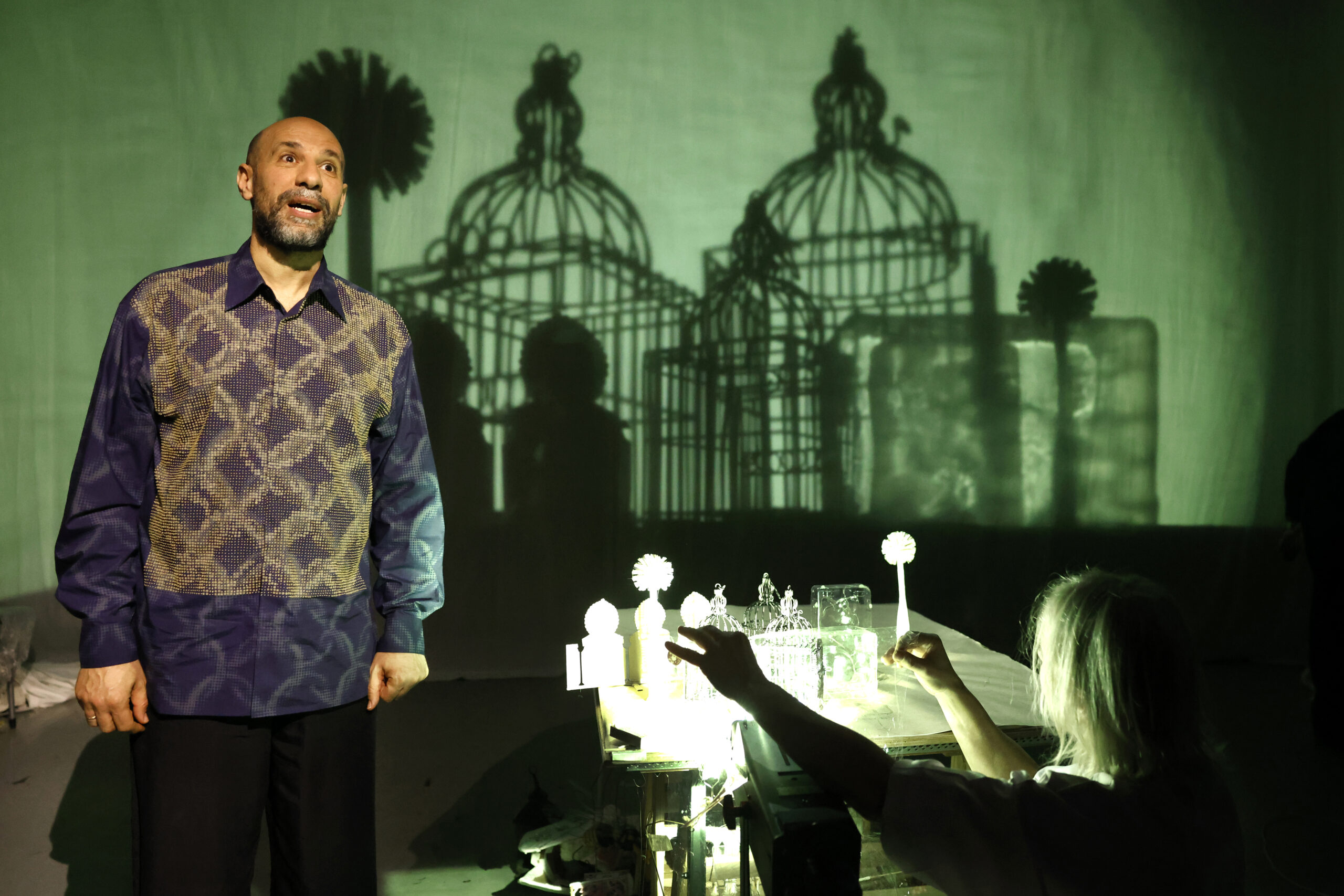
The Fall of Granada begins with Benali telling the powerful, compelling story of his journey as a young boy from the Netherlands to Morocco. Once there, his uncle recounts the vibrant, vivid and fragrant history of this Arab world. His uncle speaks of a community in which Muslims, Jews and Christians lived together in peace, while Hotel Modern’s Herman Helle, Pauline Kalker and Arlène Hoornweg deploy a variety of inanimate objects to project their visual version of his story onto the backdrop. In their hands, toothbrushes are instantly transformed into street lamps, toilet brushes become Mediterranean pine trees, chicken wire models form traditional Spanish homes influenced by Arab styles, and deodorant bottles are towers in an idyllic skyline – and all the while, Chris Saris’ evocative music beautifully enhances this imaginative vision.
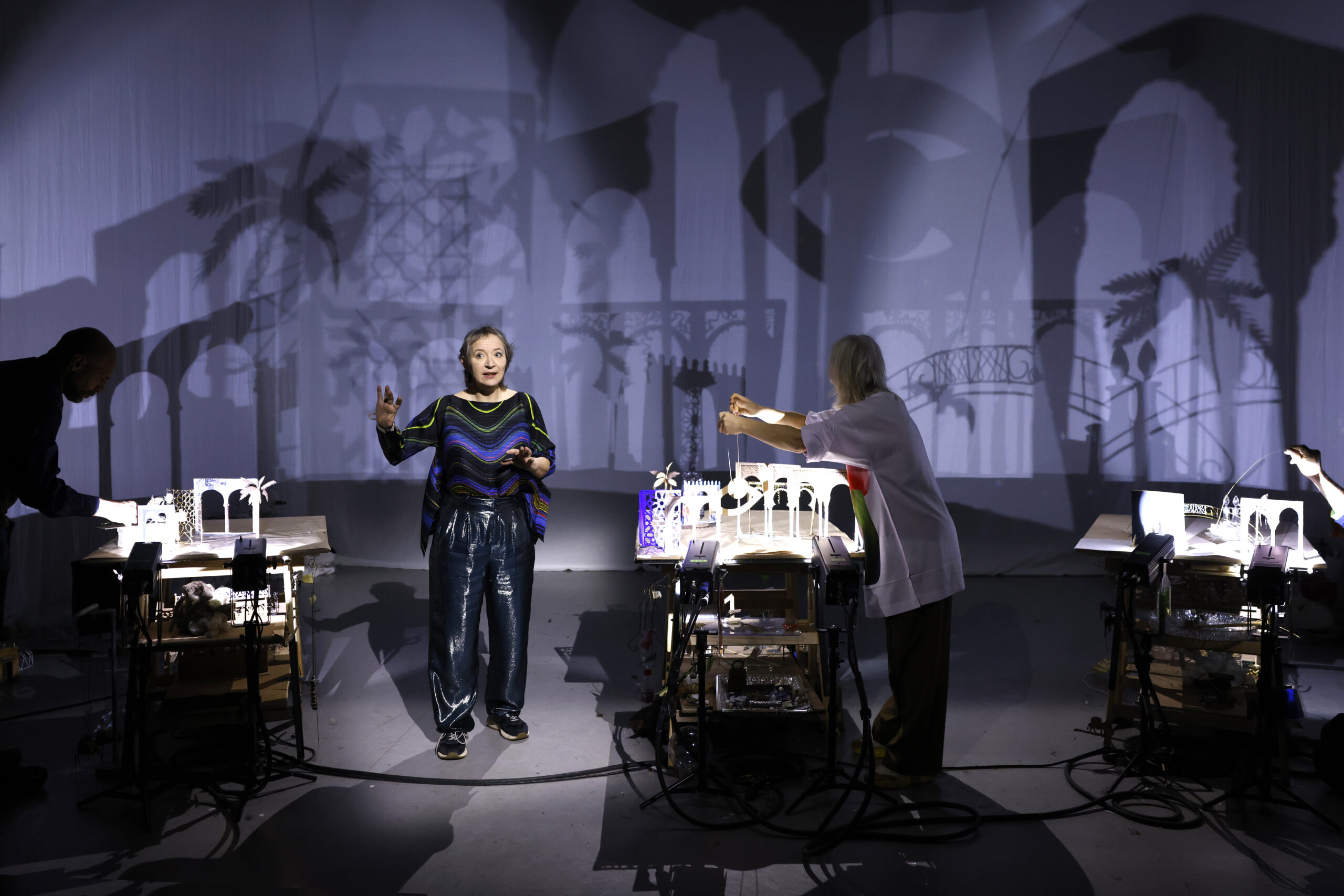

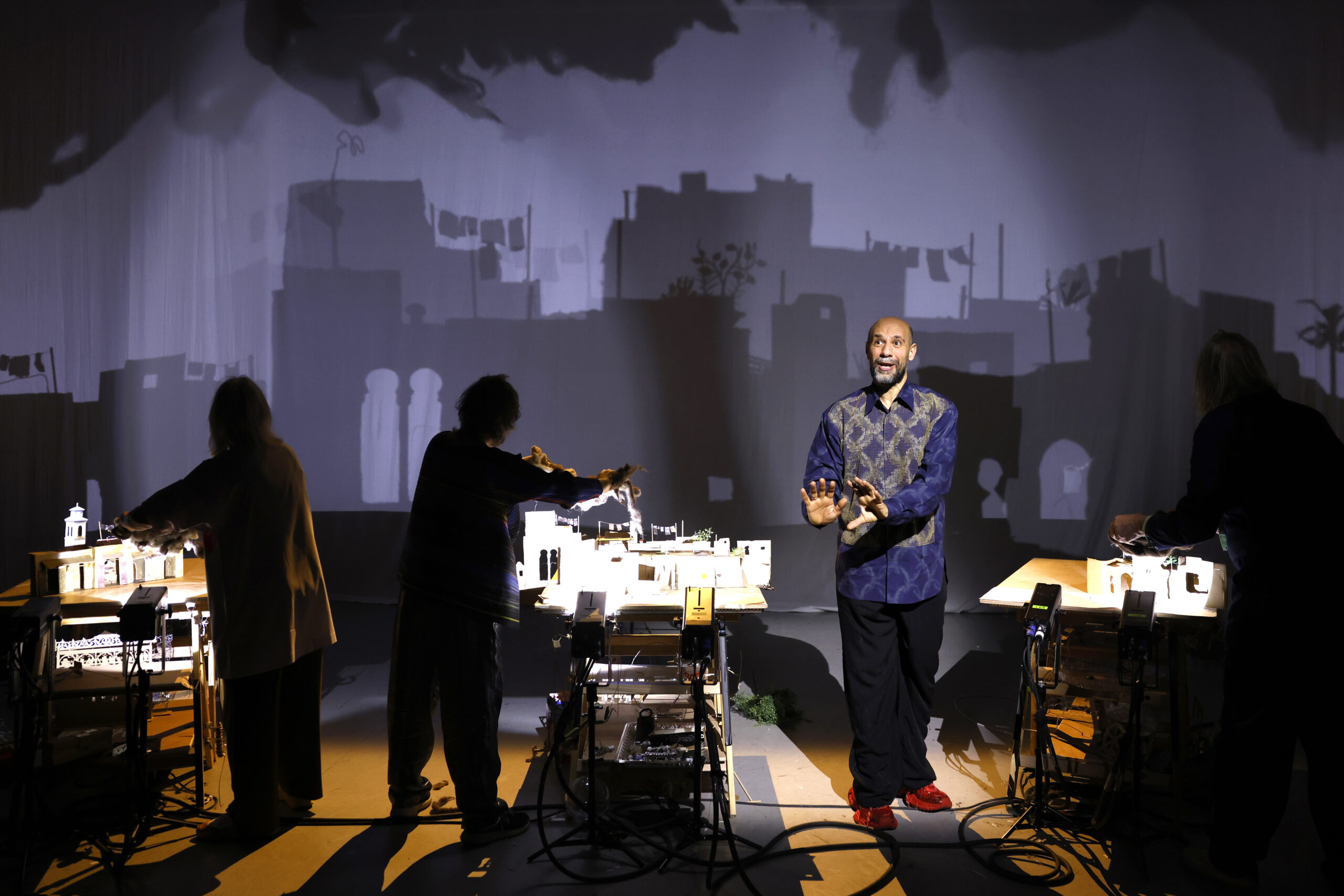
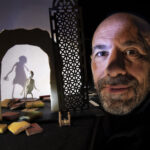
We see all these objects arranged across three large tables onstage. Using specially designed lamps, each with their own meaning and character, Hotel Modern brings them to life to accompany the stories told by Benali. In some ways the visuals resemble a Javanese shadow play, although the sticks used in this form to move hands and feet are absent – for the static objects on the tables, at least. The free-flying birds, however, move through the scene, with the ever-present and continually creative cast members sometimes performing themselves. Hotel Modern’s unique theatrical language is intact and as distinctive as ever here, but with Plato’s cave of shadows now serving to reflect our imaginative powers.
Compelling
The overall result is a compelling audio-visual experience in which the writer (with his stories) and Hotel Modern (with their unassuming objects) bring an entire new universe to life. While this universe lies far behind us in history, and has faded from our collective imagination, we still feel its consequences in the religious violence of today. The book burnings, the destruction of hearth and home, and the arrest of the ‘aubergine woman’ who does not abide by the rules of the new rulers, are all too readily transposed into a contemporary reality. The urgent message of The Fall of Granada is evident, and deserves to be heard loud and clear – certainly if it can be told in the way it is here.
Abdelkader Benali and Hotel Modern offer the best of two worlds, showing how art and reality can merge into a single, powerful whole – one that jolts us awake and holds our attention. See this show and experience this outstanding artistic convergence for yourself.
-
A story within a story
‘When Benali conceived the story, spirits of the past began to speak him to about historical Granada, and in this play of shadows Hotel Modern devised the perfect embodiment of those spirits.’ Spotlights cast magnified shadows of the miniature buildings standing on three tables, creating the contours of medieval Granada on the white backdrop surrounding […]
by Marijn van der Jagt, De Groene Amsterdammer Read More
‘When Benali conceived the story, spirits of the past began to speak him to about historical Granada, and in this play of shadows Hotel Modern devised the perfect embodiment of those spirits.’
Spotlights cast magnified shadows of the miniature buildings standing on three tables, creating the contours of medieval Granada on the white backdrop surrounding the stage. Clotheslines hung between rooftops flutter in the wind; we hear the breath of writer Abdelkader Benali as he stands at one of the tables, blowing on a string of cardboard clothes. Then, in a harbinger of what is to come, Pauline Kalker passes a handful of fluffy material through the projection beam, causing dark clouds to loom over this city of shadows.
Hotel Modern’s The Fall of Granada tells the story of the flourishing and the falling of the Moorish kingdom of Al-Andalus, in Spain. At its centre stood the vibrant city of Granada. Before the Spanish Inquisition overpowered the city in 1492, Muslims, Jews and Christians lived together there. The emphasis that this fact receives from guest performer and storyteller Benali contrasts with worldly reality, and allows for a degree of romanticisation of the now vanished Granada.
The nested narrative begins with Benali’s Moroccan uncle taking his nephew back to the centuries-long Spanish era of their Arab ancestry and bringing to life several illustrious figures who lived in Granada. They bear witness to a pre-Christian renaissance: astronomer, inventor and scientist Ibn Farnas, for example, created a ‘flying apparatus’ here as early the ninth century, and made a gliding dive from a tower wearing armour with movable wings; musician and lifestyle innovator Zyriab transformed dining habits by introducing the three-course meal, as well as a self-made deodorant for personal hygiene; and Hebrew poet Qasmouna broke the taboo on female poets – we see her recite her poems among the clotheslines on the rooftops.
Benali’s florid language bring these city dwellers to life in a sensual, urbanist vision, while Hotel Modern conjure rich scenes of shadows, using handcrafted figures, household objects, cut-out miniature facades, and small wire and lace constructions. We see layer upon layer of openwork materials and subtle gradations of grey and scale achieved by manipulating the objects’ distance from the light sources. Flowers, trees and enormous insects evoke a natural paradise before Benali reveals that ‘Wherever the Arabs came, they first made a garden.’ Live musician Chris Saris, meanwhile, heightens the narrative impact of the shadow images with his associative music and impeccably timed sounds.
There is constant motion in the backdrop shadows: of tiny figures in the urban landscape scurrying past lights or turning on carousels; of a chronicler, off to one side, busily dipping a quill into an inkwell; and of the performers themselves – as well as manipulating the miniature objects, the cast act out human-scale scenes as they move among the tables,.
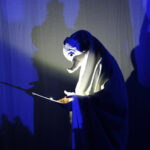
While it does get a little sentimental at times, the cumulative effect is utterly breathtaking. In the scenes depicting the Christian conquest – when smoke clouds from the burning of Jewish books hang over the city – Arlène Hoornweg plays a woman being burned at the stake for preparing a Muslim dish. Herman Helle uses miniatures to animate whirling orange flames on the backdrop around her shadow, which is surrounded by other figures mounted on stake poles. In the final scene, Ibn Farnas takes one last dream-flight over the smoke-filled city.
When Benali conceived the story, spirits of the past began to speak him to about historical Granada, and in this play of shadows Hotel Modern devised the perfect embodiment of those spirits.
De Groene Amsterdammer, 22 January 2026
-
Washing-up racks, chicken wire and toothbrushes cast shadows of a fallen Muslim empire
Hotel Modern and Abdelkader Benali were brought together by the extraordinary history of Spain. In 2023, these artists and theatre makers got to know one another while working together on a television series about the Dutchman Jan Janszoon, who in the seventeenth century migrated from his home in Haarlem to Morocco, where he became a […]
by Marjan Terpstra, Theaterkrant Read More
Hotel Modern and Abdelkader Benali were brought together by the extraordinary history of Spain. In 2023, these artists and theatre makers got to know one another while working together on a television series about the Dutchman Jan Janszoon, who in the seventeenth century migrated from his home in Haarlem to Morocco, where he became a pirate and converted to Islam. They realised they knew surprisingly little about the history of Islamic Spain and the fall of Granada, after which all Jews were forced to convert to Catholicism or leave the country if they didn’t want to end up being burned at the stake; a little over hundred years later, Muslims would meet the same fate.
Benali tells the story through his uncle in Morocco, who – like many Jews and Muslims in the country – still feels a nostalgic longing for the grandeur of Granada and Córdoba. These cities are the legacies of a great Muslim empire that started in 711 CE and ended in 1492 with the fall of Granada. Despite internal wars and the constant threat of Christian armies advancing from the north, the sciences and arts flourished here, and Muslims, Jews and Christians lived together in relative harmony.
Hotel Modern usually work with scale models and projections, but when preparing this production they decided to use a shadow-play technique to summon the vestiges of a largely forgotten past. Placed in front of the specially designed lamps, the objects positioned on the three tables onstage take on the form of gardens, cities and execution pyres.
As Hotel Modern’s Pauline Kalker, Arlène Hoornweg and Herman Helle create shadows of fluttering butterflies, Benali begins to tell the stories of notable figures from the history of Al-Andalus. The three members of Hotel Modern then also gradually transform into these men and women of the past. Helle, for example, becomes Abbas ibn Firnas (810–887), the Andalusian forerunner of Leonardo da Vinci. The experiments of this scientist, inventor and engineer, who was one of the first people to attempt to fly, inspired later developments in aviation. And other intriguing and little-known details emerge, such as that the Arabs who ruled Spain introduced the toothbrush, glassware, cutlery and the three-course meal to Europe.
What makes this production especially telling is the way Hotel Modern once again conjure an entire universe from everyday objects – transforming dish racks, rolled-up chicken wire, glue pots, whisks and toothbrushes into a vibrant city of shadows. One of the most powerful scenes depicts an execution pyre, built from a rotating platform and tongue-shaped strips of orange cellophane. And all the while, the soundscape by percussionist Chris Saris intensifies an already unsettling atmosphere.
Similar techniques are used to portray the death of a woman who makes couscous with aubergine, an act for which she is arrested by the so-called ‘aubergine police’. Pauline Kalker – who previously co-created Kamp, the Hotel Modern play about her grandfather, who was murdered in Auschwitz – was keen to incorporate stories about the city’s Jewish population. And so they bring to life the Granadan-Jewish poet Khasmuna, or Qasmūna bint Ismāʿil. And in one particularly humorous scene, set in the famous library of Córdoba, a German-speaking visitor discovers that the library contains treasured books that cannot be found anywhere else.
At times the pace slows somewhat, as the cast take their time to build the scenes. But this shift in cadence is quite welcome, because it also slows down Benali, whose has a tendency, born out of enthusiasm, to tell the story quickly and with excessive urgency. The sense of calm heightens the tension and impact of the woman’s arrest for preparing a Muslim dish. This scene is particularly haunting because we are witnessing with our own eyes something that occurred five centuries ago, in a Spain where all freedoms were denied: if you didn’t think like the Catholic monarchs, you had to leave the country or face the stake.
Following the performance, the audience were invited onto the stage to see how the final scene was created: electric toothbrushes are used for lampposts, rolled-up chicken wire topped with a whisk forms a residential tower, a mouse wheel serves as a Ferris wheel, and glue pots, dish racks and an oil-and-vinegar set evoke an entire city. Together, they seem to symbolize our fragile society, in which the shadows of the past have returned.
-
Subtle underlying message in Hotel Modern’s The Fall of Granada
Civilisations rise and fall, and so does barbarism – this is the central message of the intensely visual historical stage production The Fall of Granada by Hotel Modern and Abdelkader Benali. Hotel Modern made their name by recreating entire miniature worlds on stage, using models, figurines and everyday objects. The group used this method for […]
by Vincent Kouters, De Volkskrant Read More
Civilisations rise and fall, and so does barbarism – this is the central message of the intensely visual historical stage production The Fall of Granada by Hotel Modern and Abdelkader Benali.
Hotel Modern made their name by recreating entire miniature worlds on stage, using models, figurines and everyday objects. The group used this method for both Kamp (with its scale model of Auschwitz) and the less weighty Shrimp Tales. For The Fall of Granada they have turned to using shadow-play techniques to bring to life the medieval world of Granada, with the Alhambra at its centre, standing as a symbol of the flourishing prosperity, learning and culture of its time. Jews, Muslims and Christians lived there together in harmony. But in 1492, it all came to an end when the Catholics, through the unspeakable brutality of the Spanish Inquisition, expelled Muslims and Jews. The parallels with today are obvious, though never explicitly stated.
While Pauline Kalker, Arlène Hoornweg and Herman Helle create the shadow images and perform small acting roles, Benali tells stories from that era: stories of enlightened kings and Islamic artists; and stories of scientists who were ahead of their time, developing innovations such as irrigation and the mathematical concept of zero. Although this combination usually works well, the shadow play is sometimes reduced to an illustration accompanying its story. One particularly powerful scene shows the destruction wrought by the Spanish Inquisition, with depictions of the execution pyres, book burnings and murders. These moments hit unexpectedly hard, especially when one realises there has never been a period when such things did not happen.
-
Tourdates The Fall of Granada
- Tuesday 10 November 2026 Laurenskerk Rotterdam Netherlands
- Wednesday 11 November 2026 Laurenskerk Rotterdam Netherlands
- View all our tourdates in the agenda
-
Makers
-
makers and actors Abdelkader Benali, Pauline Kalker, Arlène Hoornweg, Herman Helle, Jorn Heijdenrijk text: Abdelkader Benali and Hotel Modern live music Chris Saris assistance props, puppets and costumes Marsha Agerbeek, Juliet Campfens, Jacqueline de Maat, Jozef van Rossum, Barbara Witteveen help with research Ravyvano van Kralingen poster and flyer Superchagerijnig, Notdef theatre technicians Joost ten Hagen, Joris van Oosterhout, Pablo Strörmann thanks to Machiel Kunst, de Lichtbende business management Inge Kruithof publicity Michiel van Zuijlen administration Ariëlle Leenheer agent: Alles Voor de Kunsten subsidy Performing Arts Fund, Municipality of Rotterdam